)
)
Club Soda’s Laura Willoughby on education, community and the future of low & no
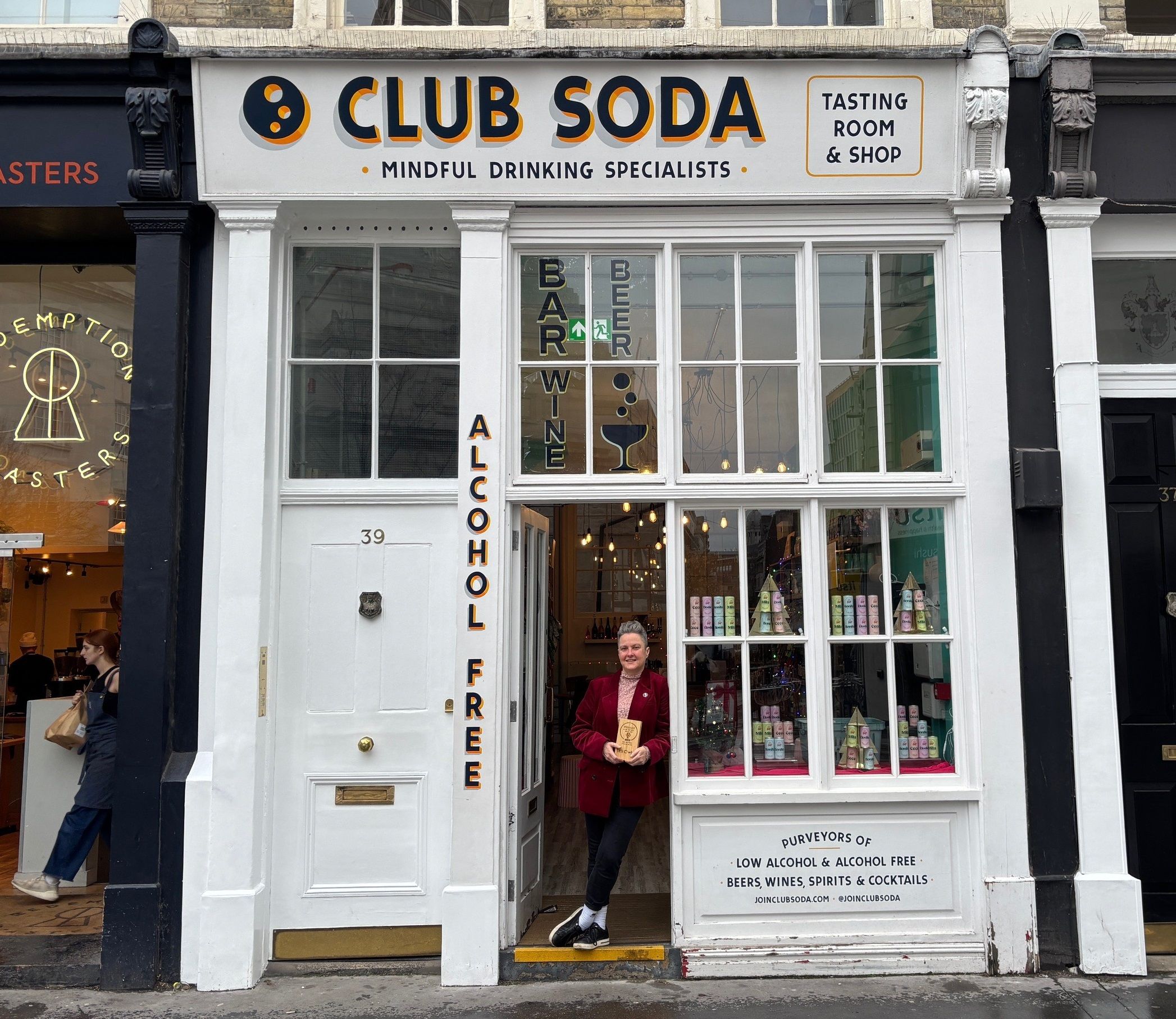
Speciality & Fine Food Fair talks to Laura Willoughby, Co-Founder of Club Soda and Small Independent Retailer of the Year winner, about championing small brands, driving category change and building an education-led retail space for the low & no community.
When Club Soda was named Small Retailer of the Year at Speciality & Fine Food Fair, Co-Founder Laura Willoughby saw it as recognition not only of a brick-and-mortar shop, but of a wider mission to educate both consumers and the trade.
Reflecting on the award, she says, “It was great. It was really lovely to not only be recognised for the fact that we've got a shop, a retail space, but that this retail space is something so much more. I always call it an education space, it's here to educate the consumer and the trade.”
From the outset, Club Soda’s venue in central London has served as a showcase for independent brands. Laura stresses that the business is built on collaboration: “It's really great for the brands, because we can't do this space without them. It is a collaboration with them; they make this space happen.”
She adds that the model demonstrates what can be achieved when a category is championed collectively. “That's what Club Soda is good at: bringing people together to do things.”
Supporting small producers
The store’s shelves are dominated by emerging brands, something Laura considers fundamental to their mission. “This is virtually all small brands in here and growing brands,” she explains. Large companies, she notes, aren’t suited to the flexible, exploratory nature of the project: “You couldn’t make this space with the big brands, because they're too difficult to work with on what is, for them, quite a small project, but it's a large project for small brands and for the category as a whole .”
What the space offers, beyond retail, is a real-time testing ground. “We can show that there is quality and choice that customers want. There's all sorts of data that we collect that we then share with both the brands and with the industry, so that we can make the case for them expanding their ranges.”
From festivals to a permanent home
Club Soda’s now-influential role in the low and no sector began long before the shop opened. Laura recalls launching the Mindful Drinking Festivals in 2017: “Our goal was to educate the consumer and go, ‘Look, there's something new, why don’t you come and try them?’”
Despite worries that no one would attend, the first event was “completely swamped”.
Lockdown pushed the team to innovate again. With in-person events off the table, they launched a pop-up alcohol-free off licence.
The response revealed demand from both brands and consumers, prompting the search for a permanent site.
Settling in the West End created its own challenges, not least the realities of central London shopping habits with consumers less willing to buy multiple heavy bottles.
Still, the space quickly became a multi-purpose hub. “We initially built the bar for sampling, but it’s quickly become quite a big component of what we do. People want cocktails, they want to try wine by the glass, they want to have dates here.”
Downstairs, Club Soda runs training for pubs, bars, restaurants, mixologists and buyers, making full use of every corner.
A space built for the community
The shop was made possible by a crowdfunder and a hands-on effort from supporters and family members. “Every lick of paint on the walls, every chair that you're sat on, was funded by our community,” Laura says. “My brother built the bar. All the staff helped to paint the walls. It was definitely people pulling together.”
That community-minded approach extends to daily operations and relationships with neighbouring businesses. “We get a lot of trade coming in, which means that we can educate that community. We are a social impact business, so it's not always about profit at the end.”
How the category has transformed
Laura’s own journey into alcohol-free options began 13 years ago (in a full circle moment, her last drink was in the pub opposite the shop), when choice was virtually non-existent.
“There was Beck's Blue, and there was nothing else to have.” As Club Soda evolved from a health-tech platform into a change-making organisation, Laura recognised a systemic gap. “What we established was that there wasn't anything for [pubs] to serve. It was really with Heineken 0.0 coming out in 2017, and Seedlip just before that, that we began to go, ‘Oh, hang on…’”
Rather than choosing to launch her own alcohol free brand, she concentrated on building an infrastructure and community for what was then an underserved category.
“If nobody's stocking them, if they're not visible, if people don't know about them then we don't change anything. I'm interested in that bigger piece.”
Expert mixologists have shaped the shop’s drinks programme. “We've been really lucky to have on our staff people that understand and make great cocktails.
The team takes an experimental approach: “We don't just have to have one alcohol-free spirit in a cocktail. We can have two or three to create something exceptional.”
This expertise has fed directly into Club Soda’s new partnership with Majestic. “We've got 13 of our best-selling products in Majestic at the minute. We're running the first ever academy for their staff in January and we have designed them a range of cocktails.” Laura sees this as evidence of how a specialist physical store can catalyse wider retail change.
Laura is clear about the commercial upside for operators. “Hospitality loses £800 million a year if they're not upgrading people from water.” Pubs, she argues, must adapt to changing drinking patterns if they want to stay central to community life.
“I never want people to absent themselves from the pub just because they're not drinking. We need to just switch our cultural norm.”
Who is drinking low & no?
Despite assumptions about Gen Z, Club Soda’s customers skew older and are typically moderating. “It's every age group, but with different motivations,” Laura explains. Younger drinkers gravitate towards functional and flavour-led products, while older audiences prioritise occasion and taste consistency.
The functional category, encompassing nootropics, adaptogens and CBD, is growing fast. “That's a big selling category,” she says.
Sustainability remains embedded in Club Soda’s operations. “I started off my life as an environmental campaigner when I was 14, so it's really important to me.” The team focuses on waste reduction and energy use, while championing brands with strong ecological practices. “In amongst everything here are brands that are working really hard on sustainability.”
With the shop due to close for building works, Club Soda is exploring partnership-led ways to continue offering physical experiences. “We could pop up in someone else's space; we don't need to have a bar if already have a beautiful bar with great bartenders. But there may be space for our retail element.”
As for market trends, Laura sees three clear areas of growth.
First, alcohol-free wine: “I think we'll see wine really taking off… the quality is amazing.” Second, functional drinks: “It's gone a little bit mental in the drinks space for functional – I love it.” And third, a bigger role for independent retailers: “Every small independent retailer has the potential to increase their basket spend. If you're trusted as a judge of good taste for alcohol, then your customers will also go, ‘Excellent, what have you got that I can have for Monday or Tuesday?’”
Curation, she argues, is the key. “When you've got a limited amount of shelf space, you have to have a collection and curate it. But that's okay – we can help you with that.”
Visit joinclubsoda.com to learn more about the organisation’s extensive operations in the low & no sector.
)
)
)
)
)
)
)
)
)
)
)
)
)
)
)
)
)
)